It's probably the question I get asked most. Someone calls up, tells me they work on or near roads, and wants to know whether their van actually needs those red and yellow chevrons on the back. The honest answer is: if your work takes you onto a public highway, almost certainly yes — but let me explain exactly why, and what it means in practice.
What Actually Is Chapter 8?
Chapter 8 refers to Chapter 8 of the Traffic Signs Manual, a document published by the UK Department for Transport. It sets out guidelines for traffic safety measures and signs at roadworks and other temporary situations on public roads. The part most people are concerned with — and the part that affects tradespeople and fleet operators — covers vehicle conspicuity markings. In plain English: how visible your vehicle needs to be when it's stopped or working on a road.
It's worth being clear about one thing: Chapter 8 is guidance, not legislation in the traditional sense. However, in practice the distinction rarely matters. Local authorities, utilities companies, construction firms, and most major contractors make Chapter 8 compliance a condition of contract. If your vehicle doesn't have the right markings, you won't be allowed on site — full stop. Beyond contracts, non-compliant vehicles can also cause serious problems with your insurance if there's an incident.
Worth knowing: The relevant section of the Traffic Signs Manual is Section U4.3 — Vehicle Conspicuity Markings. It applies to any vehicle stopping or operating on a high-speed road (defined as 40mph or above) for work purposes.
Who Actually Needs Them?
This is where a lot of people get confused. The short version is: if your vehicle ever stops on a public road — whether that's a motorway, A road, or even a busy B road — while you or your team are working, Chapter 8 markings are what the Traffic Signs Manual recommends. That covers a much wider range of trades than most people realise:
- Highway maintenance and road repair contractors
- Utilities companies — gas, water, electric, telecoms
- Tyre fitting and breakdown recovery
- Traffic management and escort vehicle operators
- Plant hire and haulage companies
- Local authority vehicles attending street works
- Any trade where the van stops roadside regularly
If you're a mobile tyre fitter, a telecoms engineer pulling cable along a verge, or a drainage contractor — your van qualifies. We've fitted Chapter 8 markings to everything from small Citroën Berlingos up to full HGVs and specialist plant machinery.
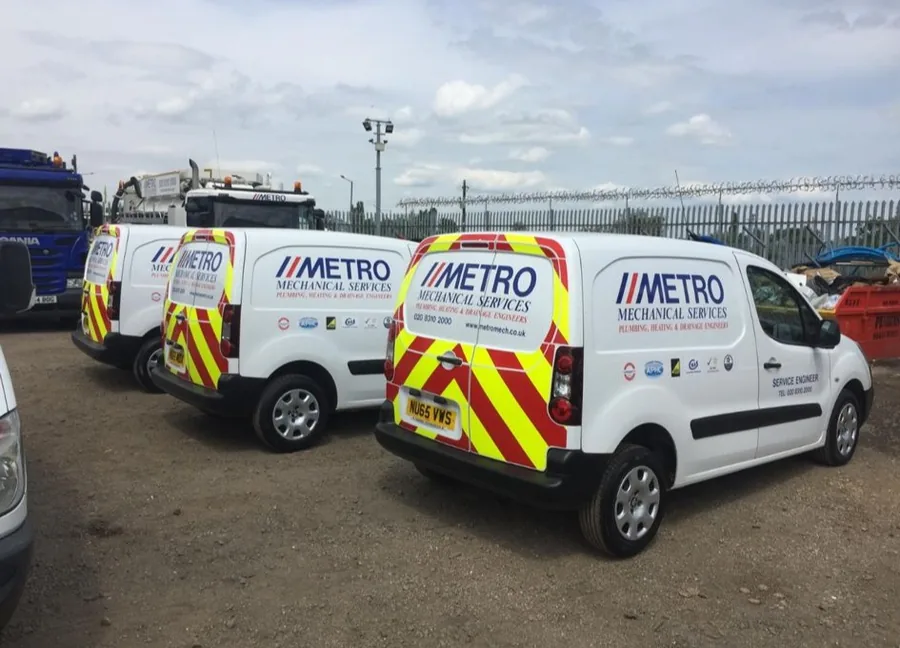
Metro Mechanical Services fleet — all marked to Chapter 8 specification.
What Are the Actual Requirements?
The specification for Chapter 8 rear chevrons is quite precise, and this is where cutting corners gets people caught out. Here's what the manual actually requires:
- Alternating red and yellow-green stripes, angled at 45–60° pointing upwards toward the nearside of the vehicle
- Each stripe must be a minimum of 150mm wide
- Red stripes must be retro-reflective (they light up at night when headlights hit them)
- Yellow-green stripes must be fluorescent for daytime visibility
- The markings must cover as much of the vehicle's rear as possible without obscuring lights, windows, or number plates
- For maintenance vehicles, "Highway Maintenance" text is required — minimum 70mm high for traffic management vehicles, 140mm for all others
The material matters: Not all reflective vinyl is equal. Chapter 8 markings need to meet retro-reflective performance standards. We use approved Class 2 and Class 3 materials — Class 3 is the higher spec and is increasingly required by large contractors and utilities companies.
What About Escort Vehicles?
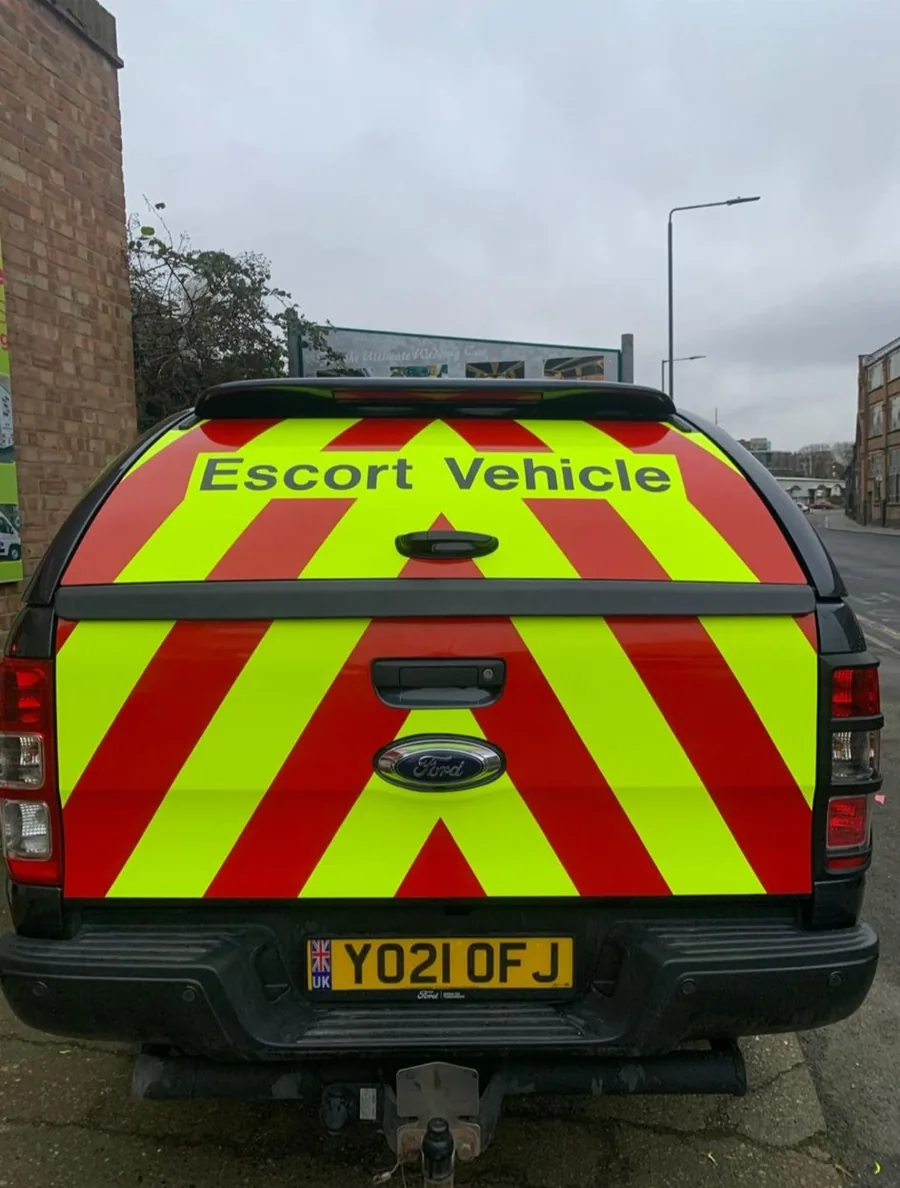
Escort and pilot vehicles — the ones accompanying abnormal loads on public roads — have their own specific requirements on top of the standard chevron specification. These include "Escort Vehicle" lettering in black on a yellow-green background, amber warning beacons, and in some cases front-facing markings as well. The rules here come partly from Chapter 8 and partly from STGO (Special Types General Order) regulations.
We do a lot of escort vehicle markings and it's an area where getting the details right really matters. A non-compliant escort vehicle can result in a load movement being refused at the roadside by police or Highways England.
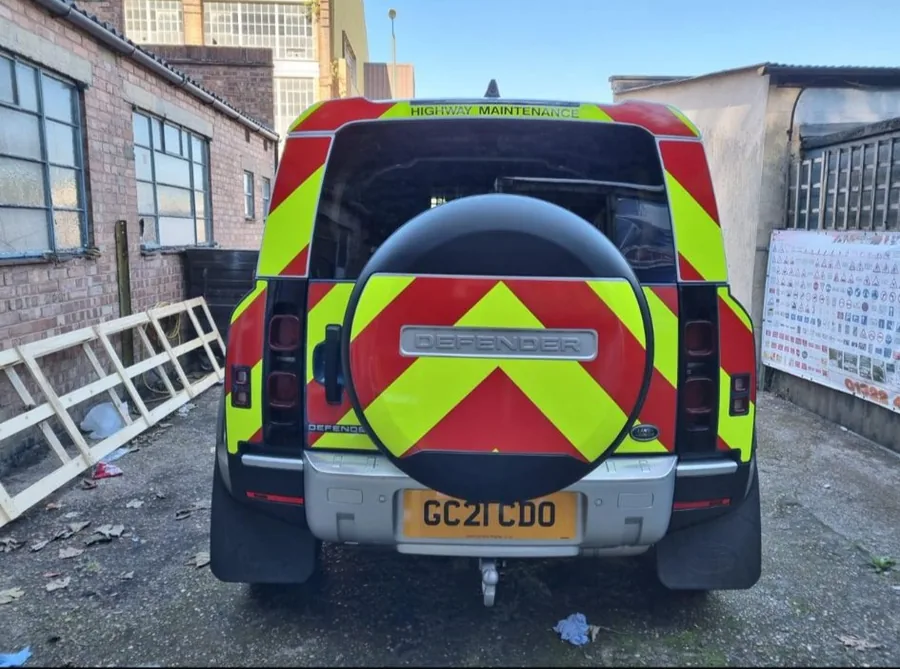
Land Rover Defender fitted with Chapter 8 markings for highway maintenance work.
What Happens If You Don't Have Them?
In practice, a few things. First, if you're working under a contract with a local authority, utilities company, or large construction firm, you'll likely be turned away from site — they carry out vehicle checks and a non-compliant vehicle is a liability they won't accept. Second, if there's an incident involving your vehicle while it's stopped on a road without the correct markings, your public liability insurance may not pay out. The insurer can argue the vehicle wasn't operated safely. Third, DVSA enforcement officers can issue prohibition notices at the roadside.
None of those are situations you want to find yourself in. The good news is getting your vehicle marked up properly isn't complicated or particularly expensive, and once it's done it lasts for years.
How Long Do the Markings Last?
Done properly with the right materials, Chapter 8 chevron markings typically last five to seven years. They should be inspected regularly — we'd suggest annually — and replaced if they're showing signs of peeling, fading, or reduced reflectivity. A marking that looks intact but no longer reflects properly at night is effectively useless and you're back to being non-compliant.
We offer a refurbishment service where we remove old or deteriorating markings and replace them cleanly, so you don't need to replace the whole vehicle livery if just the compliance markings need refreshing.
Can I Just Buy a Chevron Kit Online and Do It Myself?
You can, and some people do. But there are a few things worth considering. Firstly, the application needs to be done properly — the vinyl needs to be laid flat, without bubbles or lifting edges, and correctly positioned to meet the dimensional requirements. Poorly applied markings won't last and may not meet spec. Secondly, you need to make sure the material you're buying actually meets the required retro-reflective standard, not just something that looks similar. Some very cheap kits online use materials that won't pass scrutiny.
For a single vehicle it might be worth doing yourself if you're confident. For fleet work, it almost always makes sense to get it done professionally — consistency across vehicles matters, and you need a record that the markings were fitted to spec.
Need Chapter 8 Markings Fitted?
We cover all of London and the South East. Single vehicles or full fleets — give Bradley a call for a straightforward quote.